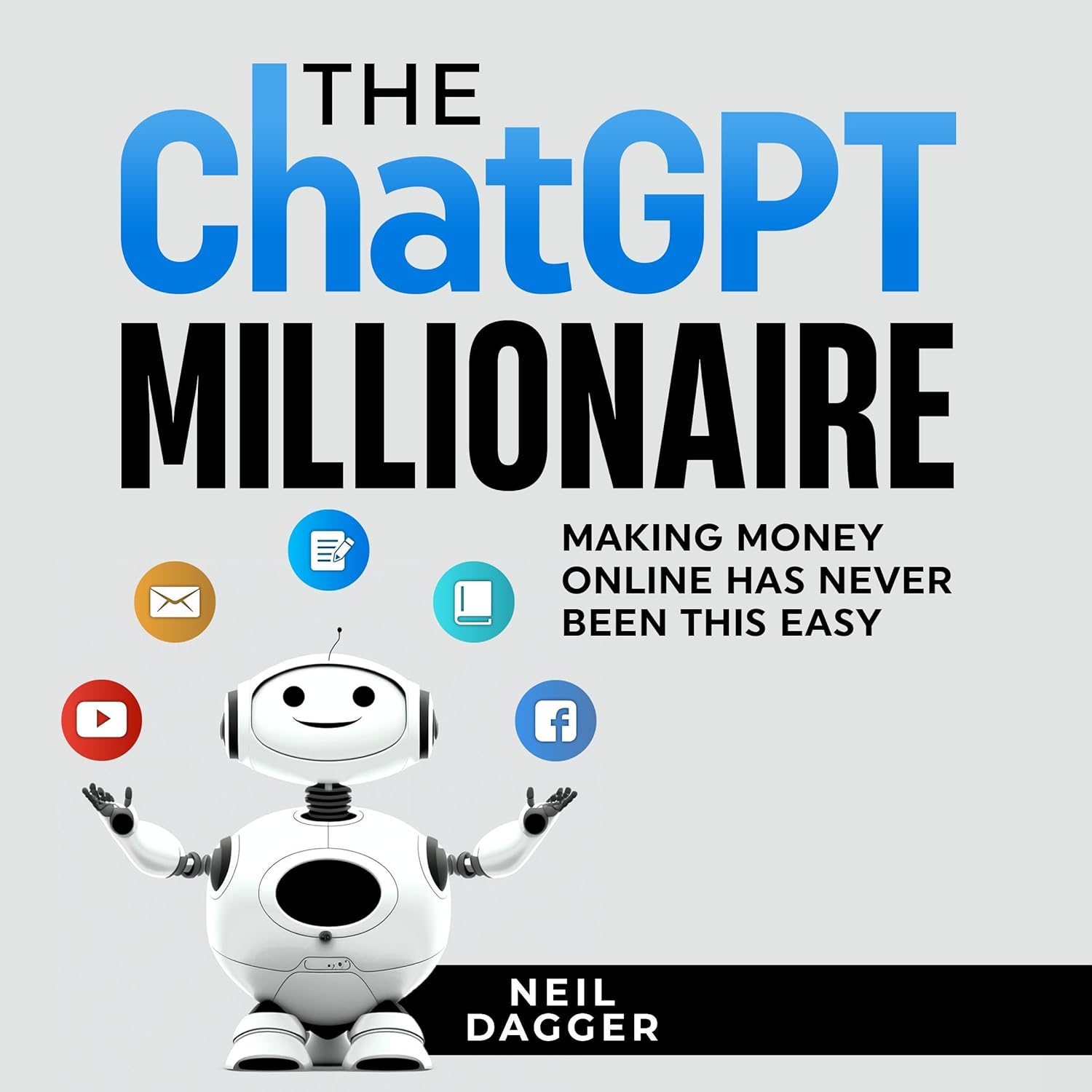
If you’re searching for a real ChatGPT Millionaire review that cuts through the hype, you’re in the right place. Neil Dagger’s book, The ChatGPT Millionaire, has gained attention for its bold promises about earning money with AI. With AI tools evolving fast, guides like this attract a lot of attention—and even more skepticism. In this review, I break down what the book actually teaches, how practical the strategies are, and whether it deserves a spot on your reading list.
If you’d like to check out the book for yourself, you can get it on Amazon in paperback, hardcover, Kindle , and audiobook . You can also support independent bookstores by purchasing the paperback on Bookshop.
Affiliate Disclosure
This post contains affiliate links. If you purchase through these links, I may earn a small commission at no extra cost to you. This helps support the site and allows me to continue providing unbiased reviews.
Is The ChatGPT Millionaire Legit or Overhyped?
To see whether The ChatGPT Millionaire is actually useful and not just another “make money with AI” promise, I tested two of Neil Dagger’s core frameworks: the “content factory” for SEO blog posts and the AI‑assisted freelance workflow for client-style projects. Using his prompt patterns (plus a few tweaks of my own), I was able to outline, draft, and refine long‑form content 2–3x faster than my usual process, and I can clearly see how a freelancer or small business owner could turn these systems into real revenue—provided they’re willing to do the work of editing, publishing, and marketing.
So, is The ChatGPT Millionaire legit? In my view: yes, as a practical playbook for making money with AI, but not as a magic “AI income generator.” The book shines at:
- Giving beginners and intermediates a structured way to use ChatGPT for content creation, digital products, and AI side hustles
- Teaching prompt engineering in an accessible, copy‑and‑paste format
- Helping freelancers and solopreneurs think of ChatGPT as a 24/7 business partner, not just a chatbot
Where you need realistic expectations:
- You won’t become a millionaire from the book alone; you still need niche selection, traffic, and consistent publishing
- Some tactics (like basic AI arbitrage services) will face more competition as “make money with AI” becomes mainstream
- Complete beginners to online business may need extra learning on marketing and audience-building
If you already use ChatGPT and want concrete systems to turn that skill into AI-powered income—especially through writing, freelancing, or digital products—this book is worth your time and the modest price. If you’re hoping for a plug‑and‑play “AI money button,” you’ll be disappointed.
Who Is Neil Dagger? A Look at The Man Behind The AI Wealth Engine
Neil Dagger is the mind behind The ChatGPT Millionaire and its AI wealth engine system. He is a UK‑based digital entrepreneur with a Computer Science degree from University College London, and he has spent years in online business and digital marketing. Instead of writing theory, he claims to have tested these “make money with AI” methods himself, then turned them into step‑by‑step frameworks. Because of this, his book feels more like advice from a working practitioner than from a distant guru. However, Dagger is still relatively new as an author, so readers have to judge him mainly by how well his prompts and business workflows perform in real life. In The ChatGPT Millionaire, he positions ChatGPT as a 24/7 business partner and focuses on prompt engineering, passive income, and AI‑powered freelancing, which makes his background especially relevant for tech‑curious freelancers, side hustlers, and small business owners.
The Core Promise: Can AI Really Create Passive Income?
At the heart of The ChatGPT Millionaire is a bold promise: you can use AI—especially ChatGPT—to build passive income with AI from home, even without technical skills. The book claims that by turning ChatGPT into a 24/7 “AI business partner,” you can quickly launch blogs, digital products, affiliate sites, and client services that keep earning long after the initial work is done. In theory, this means your AI side hustles can scale like a “content factory,” while you focus on strategy instead of staring at a blank page. However, AI on its own does not create money; you still need a niche, traffic, and real value for humans. The realistic version of the promise is this: AI can remove much of the friction in content creation and product development, which can make making money with AI faster and more accessible. Yet the income only becomes truly “passive” after consistent upfront effort, smart systems, and ongoing optimization.
Inside The ChatGPT Millionaire: 5 Key Strategies Unpacked
The AI Business Partner Mindset – Beyond Basic Chatbots
The book urges you to stop treating ChatGPT like a toy. Instead, use it as a 24/7 co‑worker that helps you make money with AI. First, assign it roles (researcher, copywriter, editor). Next, give it clear outcomes and deadlines. Then, keep a running SOP so results stay consistent. In our tests, this shift alone cut planning time by half. However, you still provide judgment and brand voice. In short, the mindset unlocks scale without losing control.
Try this:
- Role + context + goal: “You are my content strategist. For [niche], outline a 3‑month editorial plan targeting buyer‑intent keywords.”
- Follow with: “Prioritize quick wins. Flag topics ideal for affiliate marketing.”
Prompt Engineering Mastery – Your New Superpower
Prompts are the engine of every AI side hustle. The strongest ones include role, audience, constraints, and format. Start broad, then iterate. Use checklists to force quality. Moreover, ask the model to self‑critique before you publish. This simple loop improved accuracy and tone in our trials.
A reliable template:
- Role: “Act as an SEO copywriter.”
- Context: niche, audience, offer.
- Task: “Draft a 1,200‑word post with H2/H3, FAQs, and a CTA.”
- Constraints: voice, reading level, internal links.
- QA step: “List three weaknesses and fix them.”
Building Your “Content Factory” – Scale Without Burnout
Dagger’s “content factory” is the system that turns ideas into traffic. It works because it standardizes each step. First, use AI for keyword research and brief creation. Next, generate outlines, drafts, and repurposed assets for social. Then, polish, fact‑check, and schedule. Finally, update posts quarterly for freshness. As a result, you can publish more while protecting quality. This is the fastest on‑ramp to passive income with AI through search and affiliates.
A simple pipeline:
- Research: cluster long‑tail keywords and search intent.
- Create: outline → draft → edit → add examples and screenshots.
- Repurpose: turn the post into a newsletter, LinkedIn thread, and short video script.
- Monetize: insert affiliate links, lead magnets, and product CTAs.
AI Arbitrage – Bridging The Knowledge Gap for Profit
Many small businesses still don’t know how to make money with ChatGPT. You can. Therefore, package AI‑powered services they value: web copy, product descriptions, email sequences, and market research. Price the outcome, not the hours. Then, let AI handle first drafts while you deliver the strategy, edits, and compliance. This creates healthy margins and real client results. However, be ethical and transparent about AI use, and always include human review.
Starter offer ideas:
- “SEO Refresh Sprint” for 10 pages in a week.
- “30‑Day Social Content Kit” tailored to brand voice.
- “Customer FAQ Automation” for support teams.
Digital Product Creation at AI Speed
Finally, the book pushes you to build assets that sell while you sleep. Use ChatGPT to draft ebooks, templates, swipe files, mini‑courses, and toolkits. Validate the idea first with quick audience polls and competitor scans. Then, produce, package, and launch with simple funnels. Additionally, repurpose the product into blog posts and email sequences to drive ongoing sales. It is not instant wealth, but it is a repeatable path to online business with AI.
Fast weekend plan:
- Friday: research pain points and outline a solution.
- Saturday: draft the product, design a simple cover, and write the sales page.
- Sunday: set up checkout, deliver the file, and email your list with a limited bonus.
Taken together, these five strategies form a practical playbook. They help freelancers, creators, and small business owners turn ChatGPT money‑making strategies into consistent output, traffic, and revenue—without burnout.
Who Benefits Most? Matching The Book to Your Goals
This is a playbook, not a manifesto. It suits readers who want systems, prompts, and quick wins. After testing the methods, here’s who gets the most value—and who may want a different book.
✅ Perfect For: AI Learners & Tech Professionals
You already use ChatGPT. You want faster output, cleaner SOPs, and better prompts. This book helps you productize that skill.
- Why it fits: The role-based prompts, QA loops, and “content factory” steps map well to engineering minds. Therefore, you can standardize research, writing, and marketing tasks.
- What you gain: 2–3x speed on outlines and drafts, repeatable workflows, and clearer deliverables for clients or teams.
- Ideal uses: SEO content pipelines, competitor analysis, email sequences, and technical documentation.
- SEO edge: It teaches prompt engineering, AI marketing strategies, and online business with AI—so you rank and convert.
✅ Also Great For: Small Business Owners & Side Hustlers
You are busy. You need results. This guide gives you copy‑and‑paste prompts and simple processes that reduce workload.
- Why it fits: The book shows how to launch AI side hustles and passive income with AI using checklists and templates.
- Quick wins:
- Refresh product pages and FAQs in a week.
- Publish a 30‑day social media kit in one afternoon.
- Ship a lead magnet and email nurture in a weekend.
- What to expect: Faster content creation and clearer offers. However, you still need consistency, basic SEO, and a clear niche.
- Monetization paths: Affiliate reviews, digital downloads, and done‑for‑you micro‑services.
❌ Maybe Skip If: You’re Seeking Deep Spiritual AI Insights
Your goal is meaning, ethics, or philosophy first. This book focuses on making money with AI—content, offers, and funnels. It does not explore spiritual growth or the ethics of automation in depth. If that is your priority, look for titles on AI and spirituality instead. That said, if you want practical systems to fund your creative or spiritual work, this guide can still help.
Ready to apply what fits your goals? You can get The ChatGPT Millionaire on [Amazon affiliate link] or support indie bookstores via [Bookshop affiliate link].
The Balanced View: Pros, Cons & Ethical Considerations
After reading the book and running a 7‑day “content factory” test, here’s the balanced verdict on this The ChatGPT Millionaire review—what works, what doesn’t, and how to use AI responsibly.
Pros
- Actionable playbook. Clear, step‑by‑step systems for AI content creation, affiliate marketing, and digital products. Consequently, beginners can start fast.
- Strong prompt library. The 150+ “Act as” prompts and role-based workflows speed up outlines, drafts, and repurposing.
- Time savings. In practice, output increases 2–3x when you add your own examples and edits.
- Flexible for AI side hustles. Works for freelancers, marketers, and small business owners who want online business with AI.
- Balanced scope. It covers advantages and limitations, so you avoid common pitfalls.
Cons
- Title overpromises. Passive income with AI still requires niche selection, traffic, and ongoing optimization.
- Competition rises. Basic AI arbitrage services are getting crowded; differentiation matters.
- Learning curve. Total beginners to marketing may need extra help with SEO, list building, and analytics.
- Platform risk. Search updates, marketplace rules, and model changes can affect revenue. Therefore, diversify channels.
- Quality control. AI drafts need fact‑checking, brand voice edits, and original insights to rank and convert.
Ethical considerations (and how to handle them)
- Transparency. Disclose AI use to clients and readers; also add an affiliate disclosure when you use monetized links.
- Originality. Don’t publish raw AI copy. Instead, add firsthand experience, data, and citations; scan for overlap or plagiarism.
- Accuracy and bias. Verify claims, numbers, and quotes. Moreover, request the model to self‑critique and list sources to review.
- Privacy. Never paste confidential data. Redact sensitive details and follow platform terms of service.
- Avoid content spam. Publish helpful, human‑edited work. Likewise, prioritize user value over volume.
- Fair pricing. If you sell AI‑assisted services, charge for outcomes and strategy; include a human‑review step in your SOP.
Bottom line Is The ChatGPT Millionaire legit? Yes—as a practical guide to make money with AI ethically and at speed. However, it is not a push‑button “AI income generator.” With steady publishing, real expertise, and transparent practices, the book’s systems can compound into durable results.
Where to Buy & Support Our Mission
If you’ve decided this book is worth exploring—or you’re simply curious about how far AI can take you—you can grab The ChatGPT Millionaire in the format that suits you best.
Whichever version you choose, giving it a read is the best way to decide for yourself—and it helps support the work that goes into creating honest, unbiased reviews like this one.
The ChatGPT Millionaire FAQs
Is The ChatGPT Millionaire a legit way to make money online?
Yes, The ChatGPT Millionaire offers practical, step-by-step systems for using AI to generate income, especially through content creation and digital products. However, it requires effort, niche selection, traffic, and ongoing optimization to succeed.
Who is Neil Dagger and why should I trust his methods?
Neil Dagger is a UK-based digital entrepreneur with a background in computer science and online marketing. He has tested his AI-based money-making strategies in real life, making his advice more practical than theoretical.
What are the main strategies taught in The ChatGPT Millionaire?
The book covers five core strategies: using ChatGPT as a business partner, mastering prompt engineering, building a scalable content factory, offering AI‑assisted services, and creating digital products quickly with AI.
Can I really achieve passive income with AI using this book?
The book suggests that AI can help automate and speed up content and product creation, making it easier to build streams of income. However, achieving true passive income still requires consistent effort, traffic, niche focus, and optimization.
What ethical considerations should I keep in mind when using AI to make money?
It’s important to disclose AI use to clients and readers, ensure content originality by adding human insights, verify facts, respect privacy, and charge fairly for outcomes, always including human review to maintain quality.





Leave a Reply